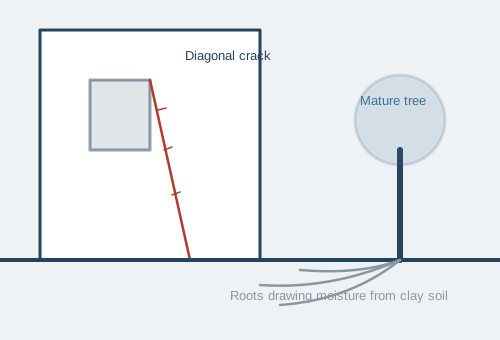
Why London Clay Causes Subsidence
Much of London is built on London Clay — a dense, fine-grained soil that shrinks as it dries out and swells as it rehydrates. In hot, dry summers the clay beneath and around a building's foundations can shrink significantly, causing the ground to settle unevenly. Where a building's foundations move with the soil, this is called subsidence; when the ground swells back and pushes upward, it's called heave. Both can cause cracking, and both are more common in London than almost anywhere else in the UK.
Warning Signs of Subsidence
- Diagonal cracks wider than 3mm, often wider at the top, near doors and windows
- Cracks that appear suddenly or grow visibly over weeks or months
- Doors and windows that start sticking or no longer close properly
- Cracks appearing at the junction between an extension and the original building
- Visible rotation or leaning in a wall or bay window
- Gaps opening between a building and paths, patios or garden walls
Not every crack means subsidence — most are cosmetic, caused by ordinary thermal movement, shrinkage of new plaster, or seasonal expansion and contraction. This is precisely why an experienced surveyor's judgement matters: distinguishing between a cosmetic hairline crack and a structural warning sign takes trained eyes.
How a Building Survey Assesses Movement Risk
During a Level 3 Building Survey, we look for:
- Crack patterns, width, and whether they're old (dirty, painted over) or fresh
- Out-of-level floors and out-of-plumb walls, checked where practical
- Proximity and species of trees, hedges and large shrubs
- Evidence of previous underpinning or remedial structural work
- Drainage issues — leaking drains can also cause localised ground movement
- Soil type and known local subsidence patterns in the area
Where movement is suspected, we'll recommend further investigation — typically a structural engineer's assessment, and sometimes crack monitoring over several months — rather than guessing at severity from a single visual inspection.
Does Subsidence Mean "Don't Buy"?
Not necessarily. Many London properties have a documented history of subsidence that was successfully underpinned decades ago and has been stable ever since — this is common and often not a barrier to a mortgage, provided it's disclosed and insured appropriately. What matters is:
- Getting a clear diagnosis of whether movement is active or historic and resolved
- Checking whether specialist subsidence insurance is required and available
- Understanding any warranty or guarantee on past remedial work
- Factoring potential costs into your offer if further investigation is needed