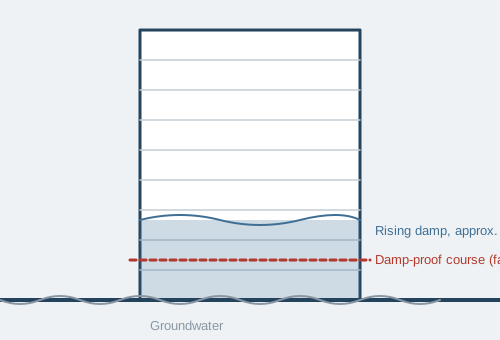
Diagram of rising damp in a solid brick wall, showing groundwater drawn up through masonry to around a metre high, with a failed damp-proof course marked
Rising damp typically reaches around a metre up a wall where the damp-proof course has failed or is missing.

The Four Types of Damp

1. Rising Damp

Groundwater drawn up through masonry by capillary action, usually where a damp-proof course (DPC) is missing, damaged, or "bridged" by raised external ground levels or solid flooring butted against a wall. Common in pre-1920s properties built before DPCs were standard. Look for tide-mark staining and crumbling plaster up to roughly a metre above floor level.

2. Penetrating Damp

Water entering from outside through a defect — cracked render, failed pointing, a leaking gutter, a defective roof, or porous brickwork. Unlike rising damp it can appear at any height and often correlates with a specific external defect that, once repaired, resolves the issue.

3. Condensation

By far the most common damp issue in occupied homes, caused by warm, moist air meeting cold surfaces — particularly in bathrooms, kitchens and poorly ventilated bedrooms. Often mistaken for rising or penetrating damp but usually resolved with better ventilation, insulation and heating patterns rather than structural repair.

4. Interstitial Condensation

Condensation forming within a wall or roof structure rather than on a visible surface — a growing risk in older solid-wall properties that have been retrofitted with modern insulation or vapour-tight materials without proper detailing. Harder to detect visually and sometimes requires specialist investigation.

Damp meters aren't the full picture Electronic "damp meters" can give misleadingly high readings on plaster, paint or certain building materials even when there's no active water ingress. An experienced surveyor interprets readings alongside visual evidence rather than relying on a single number.

Timber Decay: Wet Rot, Dry Rot & Woodworm

Wet Rot

Occurs where timber stays consistently damp — around leaking gutters, defective flashings, or damp sills and floor joists. Generally localised to the wet area and resolved by fixing the moisture source and replacing affected timber.

Dry Rot (Serpula lacrymans)

The most serious form of timber decay. Despite the name, it needs damp timber to start, but can then spread through masonry and plaster in search of new timber to attack, even into apparently dry areas. Identifiable by a musty smell, cotton-wool-like fungal growth, and rust-coloured spore dust. Treatment is more invasive and costly than wet rot, sometimes requiring removal of affected plaster and masonry as well as timber.

Woodworm (Wood-Boring Beetle)

Small round exit holes in structural and decorative timber, most commonly from common furniture beetle. Historic, treated infestation is common in older properties and not automatically a concern; active, untreated infestation in structural timber (roof or floor joists) needs professional assessment and treatment.

What This Means for Your Purchase

  • Condensation and minor historic woodworm are common and rarely deal-breakers
  • Rising and penetrating damp are usually fixable, but get a specialist quote before finalising your offer
  • Active dry rot or extensive structural timber decay can be expensive to remediate and should be factored seriously into negotiations
  • Always ask whether previous remedial damp-proofing work comes with a transferable guarantee
Typical repair costs (indicative) Re-pointing/damp-proof course renewal: £1,500–£4,000. Localised wet rot repair: £500–£2,000. Dry rot treatment: £3,000–£10,000+ depending on extent. Always get a specialist contractor's quote for an accurate figure.

Worried About Damp or Timber Issues?

A Level 3 Building Survey identifies damp and decay before you commit to buy.

Get Quote
Get Started

Ready to Book Your Survey?

Tell us about the property and we'll come back with the right survey level within 24 hours.

Step 1: Property Details

Step 2: Your Contact Details

Your details will only be used by Byrne & Co Surveying to respond to your enquiry. Read our privacy policy.

Need Help?

Coverage Area

All London postcodes and the M25 corridor.

Response Time

Within 1 working day. Open Monday, Tuesday, Wednesday, Thursday and Friday, 8am–6pm.

Damp & Timber FAQs

FAQs on Damp and Timber Decay in London Homes

Is damp a common problem in London's older properties?

Yes, rising and penetrating damp are among the most frequent findings in Level 3 Building Surveys on London's Victorian and Edwardian terraces, largely due to ageing damp-proof courses and solid brick walls.

Does a mortgage valuation check for damp?

Not reliably. A mortgage valuation is a brief inspection for the lender's purposes and often won't identify damp or timber decay the way a dedicated Level 2 or Level 3 survey will.

What's the difference between wet rot and dry rot?

Wet rot is usually localised and linked to a specific source of moisture, while dry rot can spread further through masonry and timber even after the moisture source is removed, making it more serious to treat.

How much does damp or timber treatment typically cost in London?

Costs vary widely depending on severity and the extent of the property affected, which is exactly why a survey's repair guidance and cost indication are useful before you commit to buying.

Can damp be fixed before I complete on a London property?

In some cases sellers agree to treat damp before completion, though more often it's factored into price negotiations or handled by the buyer afterwards, depending on severity.

Does a basement or lower ground floor flat have a higher damp risk in London?

Yes, basement and lower ground floor flats are generally more exposed to rising damp and penetrating damp, so we pay particular attention to these areas during inspection.